
Stone County Federal Release Scope
The Federal Bureau of Prisons manages sentenced federal prisoners and maintains a national inmate locator. The Stone County research found no BOP institution inside the county. A person with a Stone County arrest or detention link may have been held temporarily at Stone County Correctional Facility under a federal arrangement, moved by the U.S. Marshals Service, housed in another contract jail, or later designated to a BOP prison outside Mississippi. Those stages do not create a local BOP facility.
Jurisdiction determines the right record. The Stone County roster and jail docket document the county facility’s custody and its relinquishment of the person. The U.S. Marshals Service handles much federal pretrial detention and prisoner movement. BOP becomes the central public search for a sentenced federal prisoner in its system. The federal court docket supplies the case, sentence, and later judicial orders. ICE is separate and uses a different locator.
| Custody stage | Primary public route | What it can confirm |
|---|---|---|
| Stone County booking | Sheriff roster and jail docket | Local confinement and how Stone relinquished custody. |
| Federal pretrial or transport | USMS and federal court | Federal commitment, movement, and case status. |
| Sentenced federal prison | BOP Inmate Locator | Federal prison location or historical BOP release information. |
| Immigration detention | ICE locator | Current or recent ICE detention record within its scope. |
Search Stone County BOP Releases
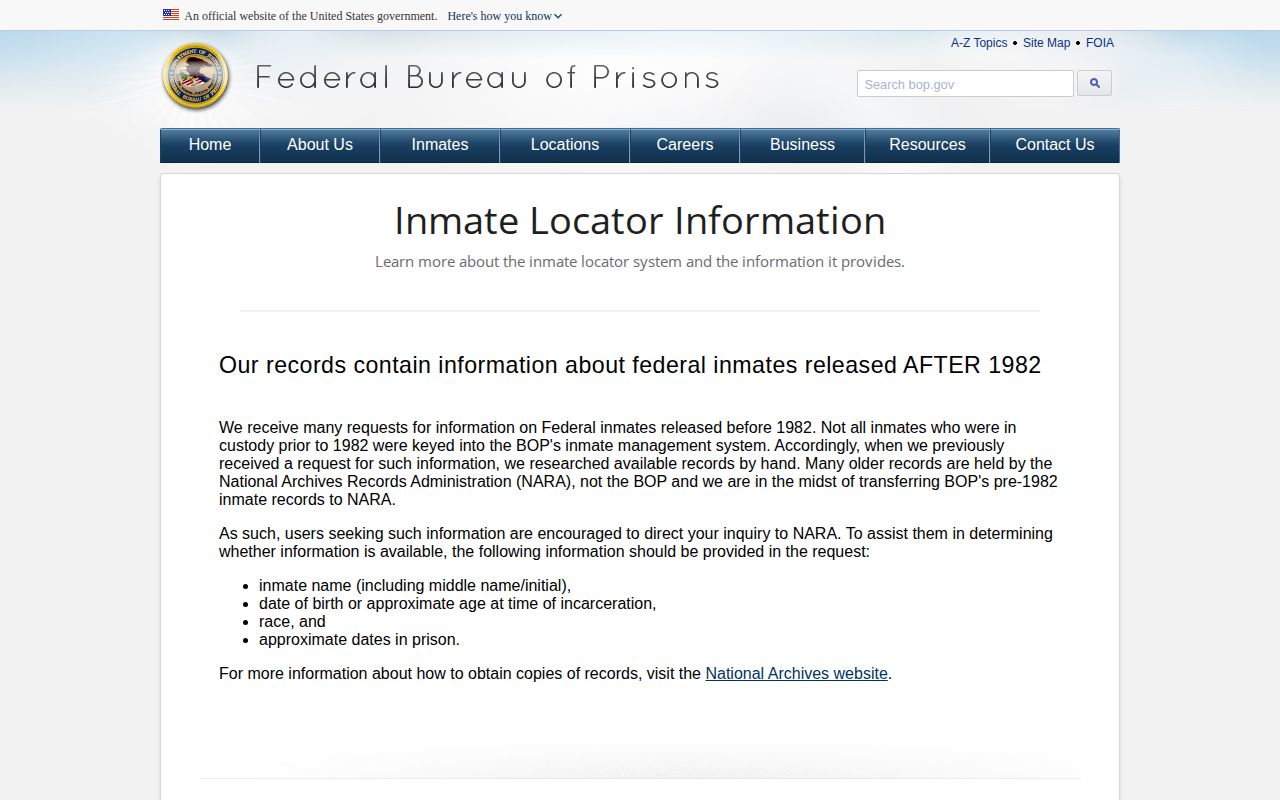
The BOP Inmate Locator covers federal inmates released after 1982. Search by a federal register number when known because it is a stronger identifier than a name. The locator also accepts name fields. When several candidates appear, compare age, race, sex, register number, and any shown institution or release information. Do not attach a federal record to a Stone County booking on name alone.
- Open the official BOP Inmate Locator.
- Choose number search and enter the register number when available.
- Otherwise use the name search with the most complete spelling known.
- Compare identity fields across every likely match.
- Read the release date and custody wording exactly as displayed.
- Check the federal docket or BOP record when the meaning or destination remains unclear.
A displayed past release date with no current facility can establish that the person is no longer in BOP custody. BOP may also use wording such as “Released” or “Not in BOP custody.” That statement is system-specific. It does not prove the end of federal supervision, a state hold, local custody, or immigration detention. A future date is projected rather than completed.
Historical coverage has a firm boundary. The locator covers federal inmates released after 1982, so a missing older record may fall outside the public database. It may also reflect a name variation or a person who was never committed to BOP. Use the federal court file and agency records for cases the locator cannot resolve.
For a wider Stone County custody search that separates county, MDOC, and federal records, use the Stone County released-inmate search path.
Note: Record the register number and retrieval date so a later inquiry stays tied to the same federal person record.
Stone County Federal Release Fields
BOP results use federal correctional terms. Read them within the locator’s scope. A current institution points to BOP custody. A historical release date points to departure from BOP custody. “Unknown” and “In Transit” do not confirm release, and a projected date may change before the event.
| BOP field or wording | Careful interpretation |
|---|---|
| Register number | The best public identifier for distinguishing federal records. |
| Current facility | The institution assigned in the BOP record. |
| Release date | Past dates may document departure from BOP custody; future dates remain projected. |
| Released / not in custody | The person is outside BOP custody, not necessarily outside every authority. |
| In Transit | Movement within the system, not community release. |
| Unknown | No reliable release conclusion can be drawn from that field. |
The official BOP locator field guidance explains the released-record meanings.
The BOP guidance makes the key boundary clear: its status describes federal prison custody and should not be enlarged into a claim about every other jurisdiction.
- Pretrial detention
- Custody while the federal case is pending, often managed through USMS rather than a sentenced BOP placement.
- Designation
- The assignment of a sentenced person to a federal institution.
- Transfer
- Movement between custodians or sites without release to the community.
- Supervised release
- A court-ordered federal supervision term that can follow imprisonment.
Stone County USMS Custody Records
A person can be in federal custody without appearing as a current BOP prisoner. The U.S. Marshals Service is central to federal pretrial detention, court production, and transport. Stone County Correctional Facility has an intergovernmental agreement that permits specified USMS, BOP, and ICE detainees to be housed there. The agreement does not transform the regional jail into a BOP institution.
When the local roster no longer shows a federal detainee, ask the Stone County custodian whether the person was released to the community or delivered to an authorized federal officer. Request the jail-docket entry, the manner of discharge, and the transfer or receiving receipt. Then check the federal case docket for detention, sentencing, release, or commitment orders. PACER’s case locator can help identify the federal case, though access and document fees follow federal court rules.
A federal defendant may move from Stone County to another contract facility, a USMS transport site, or a BOP institution after sentencing. The BOP locator may lag designation or may not answer a pretrial question. Where a federal register number has not yet been assigned or no BOP result appears, use the case and USMS custody chain rather than calling the absence a release.
Stone County Federal Handoff Rules
Stone County’s federal agreement is a distinctive release safeguard. Covered federal detainees may await trial, sentence, designation, transportation, an immigration hearing, or deportation at the regional facility. Their release is controlled by the authorized federal committing officer or process. County staff cannot treat a federal detainee like an ordinary local bond release when the federal commitment remains in force.
This creates a common false signal. A person disappears from the Stone County roster, and the observer assumes the person returned home. In fact, the county may have delivered that person to USMS, BOP transport, or ICE. The sheriff’s statutory jail docket should distinguish release from transfer and preserve the receiving officer’s receipt when applicable. The destination source must then confirm intake.
Use a two-record test. First, obtain Stone County’s manner-of-release or transfer record. Second, locate the destination record, such as a BOP result, federal docket entry, or ICE locator record. If the first says transfer and the second shows custody, describe the event as release from Stone County custody into federal custody, not as release to the community.
Federal Release Records and Contacts
There is no Stone County BOP address to contact because no federal prison was identified in the county. Use national and case-specific routes. The BOP locator is the public first check for sentenced federal records. The U.S. Marshals Service prisoner-information route explains its detention and movement role. PACER and the federal district court preserve case orders. Stone County holds its own jail-docket and transfer documentation.
Federal custody routes
BOP Inmate Locator
Search federal inmate records
Search by register number or name.
U.S. Marshals Service
Federal prisoner information
Pretrial detention and prisoner-movement context.
PACER Case Locator
Locate the federal case
Use docket orders for disposition and sentence context.
For Stone County’s side of the chain, identify the person, booking date, arresting or committing agency, and approximate transfer date. Ask whether that booking ended through community release or federal delivery. Request the release warrant or transfer receipt. For BOP’s side, use the register number and exact displayed release wording. These two records answer different questions and should be reconciled rather than substituted for one another.
Note: A federal release date proves an exit from BOP custody only; verify any supervision or later custody through the responsible federal or receiving office.