
Stone County 72-Hour Release Roster
The Stone County Sheriff’s Active Roster link leads to Tiger Roster, where “Recently Released” opens the county’s verified three-day feed. The page heading reads “Released Last 72hrs.” Its URL carries the jurisdiction code stoneMS and the release-window type last72. Those details help separate the Wiggins, Mississippi system from search results for counties with the same name elsewhere.
The view rolls forward continuously. A release drops from the web display once it passes the window, and a newer event may appear after the next data exchange. The interface offers “Refresh Results,” but neither Stone County nor the vendor states a guaranteed minute-by-minute update schedule. Record the access date and time. If a person should appear but does not, call the facility before treating the absence as meaningful.
Check Stone County Three-Day Releases
Use the source path from the sheriff so the county and vendor context stay connected. The list does not work like a name-search archive. Scan the current set, open the matching action link, and retain enough identifiers to ask the custodian about the same booking.
- Start at the Stone County Sheriff page and follow Active Roster.
- Select “Recently Released” from the roster navigation.
- Verify “Released Last 72hrs,”
stoneMS, and Stone County or Wiggins branding. - Compare name, gender, and age, then open the person detail when it remains available.
- Note booking number, booking date, arresting agency, displayed schedule field, and retrieval time.
- Call 601-928-7042 ext. 0 or request the jail docket to confirm the actual custody outcome.
A person who appears under Wiggins Police as the arresting agency may still have been housed at the county facility. A local arrest does not belong in the MDOC search unless the case later produced state custody. For a narrow same-day check, the Released Last 24 Hours workflow explains how to define and verify a precise interval within this larger view.
Note: Write down the booking number because a name alone can join the wrong person to a release event.
Stone County 72-Hour Release Fields
The list-level fields are limited. They help identify a possible match without giving the full reason, destination, or actual release time. The individual screen adds context, but its scheduled date remains a planning field.
| Display field | How to read it |
|---|---|
| Action and name | Opens the available person-level booking record. |
| Gender | A basic identifier that should be checked with stronger fields. |
| Age | A basic identity clue, not a unique key. |
| Booking number/date | Identifies the booking episode for a records inquiry. |
| Arresting agency | Names the agency connected with the arrest and booking. |
| Schedule Release Date | A prospective field that can be N/A and is not an actual departure record. |
| Charge and bond rows | Roster allegations and booking data, not a court judgment. |
The person screen may also show a photograph, primary offense, age, sex, height, weight, race, hair, eyes, glasses, and charge details. Treat the booking photograph as an identity aid tied to that booking. Charges are not proof of guilt. A court docket supplies disposition, while the sheriff’s custody record supplies execution of release or transfer.
Stone County Weekend Release Window
A three-day view is useful because it spans more than one calendar day. A Monday check may still capture part of the weekend. A late-day visit may retain events from portions of three earlier dates. Yet “72 hours” is not the same as “Friday through Sunday,” and the county has not published a rule promising that weekend or holiday releases post at a set time.
The facility’s processing and the vendor’s display can be out of sync. A judge may enter a release order while staff still check another hold, arrange transport, or complete paperwork. The legal order authorizes action; the jail record shows when custody changed. Likewise, a VINE notice may arrive near the event but remains an operational alert, not a court disposition or release certificate.
When timing is urgent, state the exact interval to jail staff. Ask: “Did this booking end, at what actual date and time, and was the person released to the community or delivered to another agency?” The research found no official Stone County policy on routine exit times, weekend advancement, family waiting areas, or release-door procedures. Call before traveling rather than infer those details.
Stone County Release Destinations
Stone County Correctional Facility is a regional facility under sheriff administration with MDOC oversight for state prisoners. Local, state, and federally connected custody streams can share its address. The roster can therefore show the end of a county booking even when the person remains confined somewhere else.
| Possible outcome | Meaning | Confirmation source |
|---|---|---|
| Bond or court release | The identified local hold ended under stated authority. | Sheriff docket, release warrant, and court order. |
| Time served | The local sentence computation reached its end. | Jail time record and sentencing court. |
| MDOC transfer | The person left Stone County custody but entered or remained in state custody. | Transfer receipt and MDOC offender record. |
| USMS or ICE handoff | The county relinquished the person to a federal authority. | Sheriff transfer record plus destination intake. |
| Another county | A separate jurisdiction became custodian. | Receiving agency confirmation. |
Do not read disappearance from the active roster as freedom. If the released page and MDOC record conflict, compare booking number, MDOC ID, dates, and destination. Two records may describe two stages in the same custody chain, or they may concern different cases.
Stone County Releases After 72 Hours
The online feed is a discovery surface, not a permanent archive. After the rolling period ends, an older Stone County release will no longer appear there. The durable fallback is unusually clear because Mississippi Code § 19-25-63 requires a sheriff’s jail docket to preserve the length of confinement and how the prisoner was released or discharged. It also requires the release warrant or, for a penitentiary transfer, the receiving officer’s receipt.
Submit the county public-records form for one booking. Supply full name, date of birth if known, approximate booking and release dates, booking number, and arresting agency. Ask for the jail-docket entry, booking sheet, release or discharge entry, legal authority, and any transfer receipt. Request electronic copies and a cost estimate. Mississippi law allows reasonable actual-cost fees, but no fixed local copy schedule was found.
A focused request is more useful than a broad request for all jail material. Ask the custodian to separate and release nonexempt fields if part of a document is withheld, and request a written explanation that identifies any exemption. Mississippi Code § 25-61-5 governs access and response timing. Section 25-61-7 permits actual-cost fees and advance payment. The county form is the direct administrative route for the sheriff’s record, while judicial records follow court access rules.
Older case records can help explain the legal outcome after the roster row expires. Stone County Justice Court handles county misdemeanors and felony initial appearances. Wiggins Municipal Court handles city matters. Circuit Court handles felonies after indictment and reports online MEC coverage from 2008 forward. A blank Circuit Court search soon after an arrest does not prove there was no booking or release because the circuit file does not exist before indictment.
- Jail docket
- The statutory county record of confinement and manner of release or discharge.
- Release warrant
- The legal authority supporting the jail’s release action.
- Transfer receipt
- Evidence that another custodian received the person.
- Disposition
- The court’s result in the case, which is distinct from the jail’s custody event.
The official interface can be viewed at the Stone County Released Last 72hrs feed.
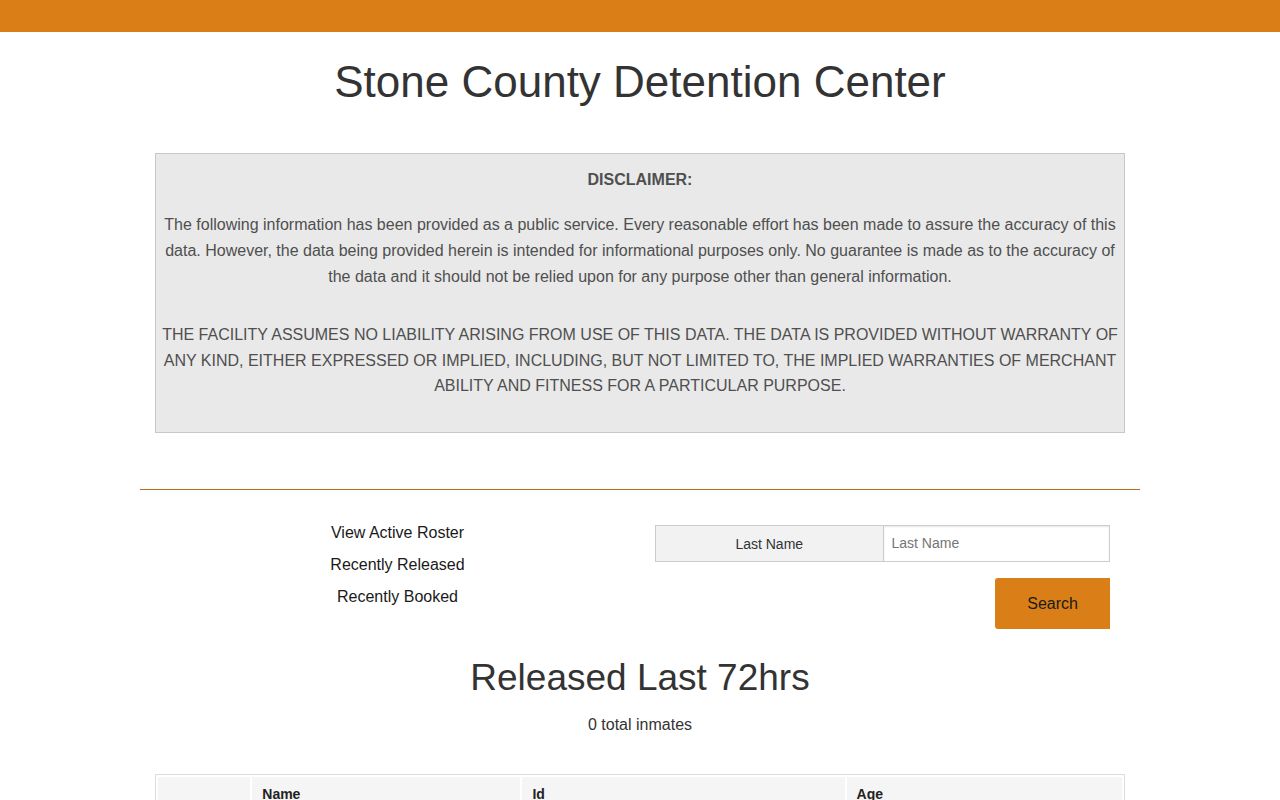
The screenshot shows the correct Mississippi source and its short-lived release window. The sheriff’s written docket remains the stronger record of how custody ended.
Note: A person older than the online window may still have a county docket and a court record even though no web row remains.