
Stone County Release Records
Stone County released inmates leave one physical setting, but they do not all enter the same legal status. A local detainee may go home after bond, a court order, time served, or completion of a county sentence. Another person may leave the Wiggins facility for an MDOC institution, another county, the U.S. Marshals Service, or immigration custody. That second event is a transfer. It is not proof that the person is free in the community. The source that records the destination is therefore as important as the fact that a name disappeared from the active roster.
The Stone County Correctional Facility is also called the Stone County Detention Center in the roster. It is a regional correctional facility run day to day by the sheriff with MDOC oversight for state inmates. Local, state, and federally sponsored custody streams can share the address. County releases are recorded by the sheriff. State sentence changes belong to MDOC. Parole decisions belong to the Mississippi State Parole Board, while MDOC Community Corrections handles field supervision. Federal and immigration records remain in their own systems.
- Discharge
- The documented end of a custody or correctional status.
- Time served
- A release tied to the amount of confinement credited under a court judgment.
- Parole
- Conditional release from prison after State Parole Board action.
- Probation
- Court-ordered community supervision that may be imposed instead of, or after, confinement.
- Detainer
- A request or legal basis for another authority to take custody.
Stone County Release Destinations
The words used on a booking or court record point toward the next check. Bond ends the jail hold for that booking subject to bond terms, but it does not decide the criminal charge. A dismissal, nolle prosequi, no bill, or not-guilty result is a court disposition and should be confirmed in the correct court file. A parole or earned-release-supervision event can end prison placement while MDOC control continues. Transfer wording calls for a destination search before anyone describes the event as a community release.
| Record wording | What it means | Next source |
|---|---|---|
| Bond or court order | The local jail hold ended under stated authority. | Stone jail docket and issuing court |
| Time served or sentence complete | Custody ended under a sentence calculation. | Judgment, time sheet, and release entry |
| Parole or ERS | Physical confinement changed to conditional community status. | MDOC record, parole action, and supervision lookup |
| MDOC or another county transfer | The person left Stone County custody but may remain confined. | Receiving system and transfer receipt |
| USMS, BOP, or ICE transfer | A federal authority became responsible. | USMS, BOP, ICE, or federal court record |
A death in custody is not a community release and must never be grouped with people who left custody alive. Likewise, a scheduled date is prospective. It can change or display as unavailable. The actual release entry, receiving officer's receipt, discharge certificate, or destination intake is stronger proof.
Stone County Release Record Fields
Mississippi Code section 19-25-63 gives the local jail docket unusual value. It requires the sheriff to preserve the confinement authority, duration, and manner of release or discharge. When a person is sent to the penitentiary, the docket keeps the receiving officer's receipt instead of treating the move as freedom. A focused request for the docket entry and its supporting release warrant or transfer receipt reaches the durable record behind the short online list.
| Field | What it establishes |
|---|---|
| Name and booking number | Connects the event to one booking episode. |
| Receipt, arrest, and commitment dates | Sets the start and authority of custody. |
| Crime or other cause | States why the person was confined, without proving guilt. |
| Length of imprisonment | Shows the duration recorded by the sheriff. |
| How released or discharged | Identifies the manner in which Stone custody ended. |
| Release warrant or transfer receipt | Shows the authority or receiving custodian. |
The vendor's individual roster record adds a photograph, booking date, arresting agency, physical descriptors, charges, bond and fine fields, and a field labeled “Schedule Release Date.” That scheduled field is not the actual exit time. The released-list classification is retrospective, yet the sheriff's docket remains better confirmation of the legal event and destination.
Request Stone County Release Records
Older Stone County releases fall off the public web view after its rolling window. Use the Stone County public-records request form for county-held material. Identify one booking episode. A broad request is harder to match and more likely to produce delay or an uncertain estimate. No fixed local copy-fee schedule was located, so ask for electronic inspection and a written estimate before chargeable work begins.
- Give the full name, date of birth if known, approximate booking and release dates, booking number, and arresting agency.
- Ask for the section 19-25-63 jail-docket entry, booking sheet, manner-of-release entry, and release authority.
- Request the bond paperwork or receiving-agency transfer receipt when either may apply.
- Ask separately for the booking photograph if it is needed to reconcile identity.
- Request native electronic copies and a cost estimate before copying starts.
1420 Industrial Park Road
Wiggins, MS 39577
601-928-3191
Monday through Friday, 8 a.m. to 5 p.m.
Mississippi's Public Records Act generally calls for production within one working day when possible. A written explanation is due when that cannot be done, and the outer period is usually seven working days unless the record itself allows a longer reasonable time. Actual-cost fees and advance payment may apply. A sealed or expunged case can change access to court and arrest material, but no order should be assumed from a missing web result.
Stone County Release Record Laws
Mississippi Code section 25-61-5 governs access and response timing. Section 25-61-7 permits reasonable actual-cost fees and advance payment. Those rules work with the sheriff's mandatory jail docket, not with the vendor's temporary display period. The research found no official statement that the full docket is destroyed after the online row expires.
Mississippi Code section 99-19-71 addresses expunction for eligible convictions and certain dismissed, dropped, no-disposition, or acquitted matters. Expunction is a legal order, not an automatic result of release. Juvenile material, sealed records, and exempt investigative material may be restricted. The record custodian should identify the legal basis for any withholding.
Stone Release Court Search Limits
All Stone County felonies begin in Justice Court. County judges conduct jail sessions three times each week to support an initial appearance within three days. A Stone Circuit Court file does not exist until indictment, even though Circuit Court cases from 2008 forward can be searched through Mississippi Electronic Courts. A blank circuit result shortly after arrest or release does not show that the case vanished. It sends the search back to Justice Court and the jail docket.
The Stone County courts directory identifies jurisdiction and contacts. Justice Court handles county misdemeanors, DUI matters, ordinance cases, and felony initial appearances. Wiggins Municipal Court handles city matters. Circuit Court carries an indicted felony file. Match the arresting agency and offense stage before choosing the clerk.
Find Stone County Released Inmates
Begin with the official Stone County Sheriff page, then follow its Active Roster link. This avoids same-name sites from other states. Choose Recently Released and confirm that the page says “Released Last 72hrs,” uses the `stoneMS` jurisdiction code, and identifies Wiggins. A released person normally leaves the active roster because that roster describes current custody. The recent list is the event view, while the jail docket is the lasting source.
- Check the county 72-hour release view and compare name, age, gender, booking number, date, arresting agency, and photograph where available.
- For an older local release, request the jail-docket entry and release warrant or transfer receipt.
- For an MDOC sentence, search by MDOC ID and compare date of birth, conviction county, offense, photograph, location, and calculated dates.
- Check the correct local court for disposition, sentence, dismissal, revocation, or completion.
- Use VINELink for status alerts, not as a substitute for the official manner-of-release record.
- Use BOP, ICE, USMS, or PACER only when a federal or immigration path is supported.
MDOC Stone Release Search
The MDOC Inmate Search covers people who entered the Mississippi state correctional system. It is not an archive of every person booked locally. Search by MDOC number when possible. With a name result, reconcile multiple identity fields before treating it as a match. The public record can include a future tentative date even when the location reflects earned release supervision, because community supervision remains within MDOC jurisdiction.
| MDOC field | How to use it |
|---|---|
| MDOC ID | Best public identifier for a state record. |
| Date of birth and photograph | Reduce same-name errors. |
| County and offense | Connect the sentence to the correct judgment. |
| Location and unit | Show prison placement or a supervision unit. |
| Tentative Release Date | A current calculation, not proof of actual departure. |
The MDOC sample detail structure shows the public labels. If full discharge matters, request the inactive master-file status, time sheet, or discharge certificate from MDOC Records. MDOC says a discharge certificate is required before release and describes a 30 to 45 day release-processing period. That certificate is stronger historical evidence than trying to reconstruct an event from a past tentative date.
The official MDOC search screen shows where an ID or name search begins. Its form is a state-sentence route, not the Stone County active jail roster.
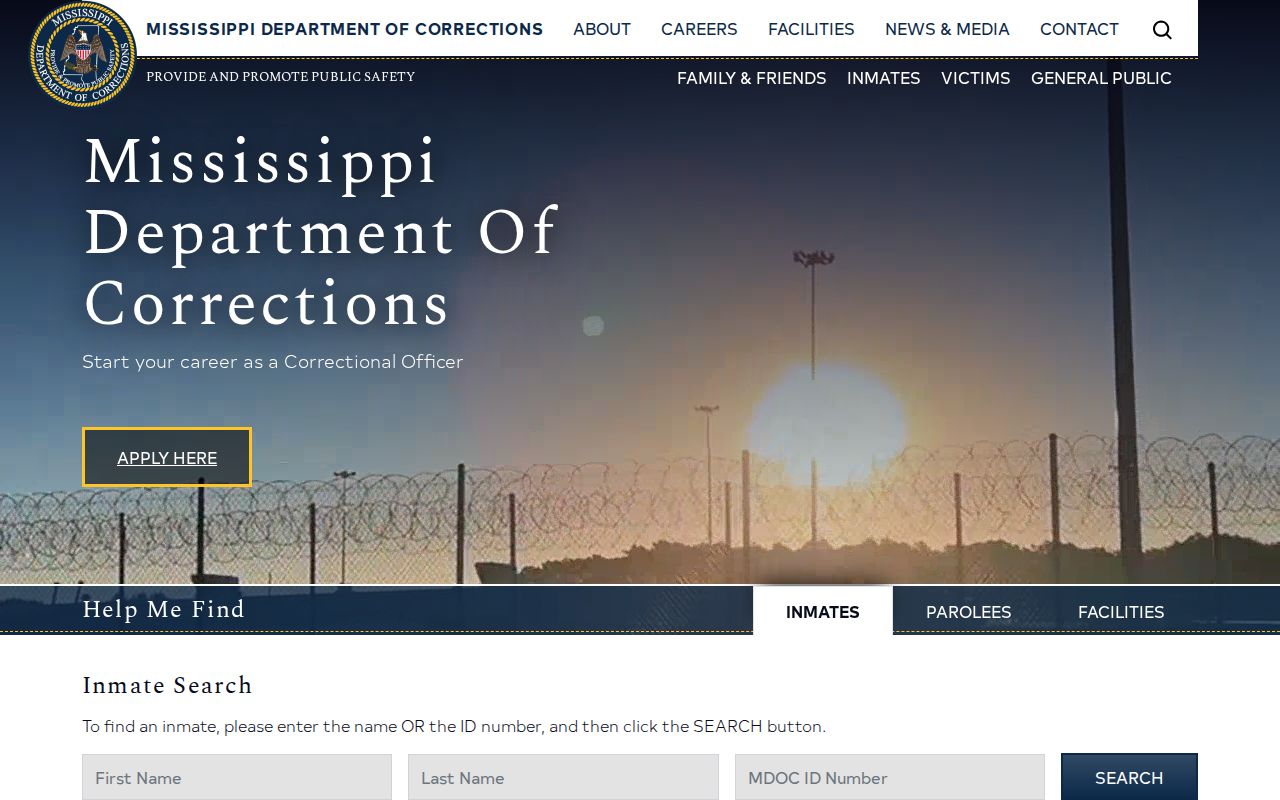
The search result must still be checked against the court judgment, supervision record, and any final discharge document.
Stone MDOC Discharge Certificates
MDOC requires a discharge certificate before an inmate's release and describes a 30 to 45 day processing period while plans and the institutional record are reviewed. That certificate is an actual document in the release process. A tentative date is only a current projection. For an old or disputed Stone County state release, ask MDOC Records for the discharge certificate, time sheet, custody history, and inactive master-file status rather than trying to reconstruct the event from a former web date.
MDOC Records accepts written public-record requests through its general-public route. The listed office is P.O. Box 24388, Jackson, MS 39225, with 601-933-2889 and MDOCRecordsDepartment@mdoc.state.ms.us as contacts. Telephone requests are not accepted as public-record requests. Use the phone or email to clarify the correct record, then make the request in writing.
Stone County Recent Release Records
Stone County has one verified official recent-release view. It is a rolling 72-hour list, not a distinct midnight-to-midnight or last-24-hours report. At list level it shows name, gender, age, and an action link. The linked detail uses the roster's booking-photo and booking-information layout. “Refresh Results” supports a live query, but neither the county nor vendor promises a fixed update interval.
The official Released Last 72hrs view should be saved with the time it was checked. If an urgent result conflicts with another source, call the Stone County Correctional Facility at 601-928-7042 extension 0. On day four and later, request the statutory jail docket. Do not turn the rolling list into a permanent local archive.
Stone Federal Custody Releases
A USMS intergovernmental agreement covers federal, BOP, and ICE detainees at the regional facility for several custody stages. Authorized federal process controls those releases. A federally sponsored detainee can leave the local roster through delivery to the committing officer, transport, designation, an immigration hearing, or deportation processing. None of those movements should be described as community release without the federal record.
No dedicated BOP institution or ICE facility was found in Stone County. The BOP and ICE locators are therefore transfer and detainer fallbacks, not replacements for the local roster. Use the Stone County relinquishment entry first. Then confirm the destination with BOP, USMS, ICE, or the federal court as the case requires.
Where Stone Releases Actually Go
Stone County's regional facility creates a mixed-custody problem. A community release, MDOC transfer, another-county handoff, USMS delivery, and ICE transfer can all remove a name from the local roster. The origin record should state how Stone custody ended. The destination system should then show whether a new custody episode began. Both sides are needed before calling the person free in the community.
Read “release” as a verb that needs a destination. County bond or time-served paperwork may point to the community. A penitentiary receipt points to MDOC. A receiving-agency entry points to another county or federal authority. When the origin and destination records agree, the custody chain becomes clear. When they conflict, ask each custodian about the specific booking and transfer rather than inferring the result from a missing name.
Stone Regional Release Context
MDOC classifies the Wiggins site as a regional correctional facility, while the county roster calls it the Stone County Detention Center. Those are overlapping descriptions of one operation. A reported 2010 expansion added 6,000 square feet and separated public and secure functions. Later audits and population reports give dated capacity snapshots. They should not be reused as current release totals or promises about present operations.
The distinction between labels matters more than the building history. A person held on a local booking follows the county release record. An MDOC prisoner at the same address follows the statewide offender and discharge record. A Wiggins Police arrest may enter the county facility and later require Municipal Court confirmation. The name of the arresting agency does not create a separate long-term municipal jail.
Compare Stone Release Search Systems
Each lookup answers a narrow question. The active roster shows who is currently listed in local custody. It cannot, by itself, prove what happened after a name dropped off. The release view provides a short event flag. Court, corrections, and federal systems cover their own records.
| System | Best use | Key limit |
|---|---|---|
| Stone active roster | Current local custody | Released people normally disappear |
| Stone 72-hour list | Very recent local release classification | Rolling, short-lived display |
| Sheriff jail docket | Manner, authority, and duration of local custody | Requires a focused request after the web window |
| MDOC search and records | State sentence, location, supervision, discharge | Does not cover every local booking |
| Court record | Charge disposition and sentence order | Must use the court with jurisdiction |
| BOP or ICE locator | Supported federal or immigration custody | Not a Stone County release archive |
Stone County Release Facilities
The facility map includes both physical detention and the outside systems that may take responsibility after a Stone County handoff. The regional facility is first. Wiggins Police is an arrest channel whose detainees can enter county custody. MDOC, BOP, and ICE pages explain the separate records that apply after transfer.
- Stone County Correctional Facility: local, state, and some federally sponsored custody at the Wiggins regional site.
- Wiggins Police Department holding and arrest channel: use the county jail record plus Municipal Court when applicable.
- Mississippi Department of Corrections facilities: statewide custody, parole, ERS, and discharge records.
- Federal Bureau of Prisons facilities: federal sentenced-prisoner custody and historical release fields.
- ICE detention network: immigration custody after a supported detainer or transfer.
Use the facility page that matches the authority, then reconcile it with the Stone County origin record. A destination intake plus the local transfer receipt prevents a transfer from being mislabeled as release.
Search Stone County Release Records
Use a full name and known location to begin. Confirm any result with the sheriff, MDOC, the proper court, or the federal custodian that created the record.
Sponsored Results